
Vancouver and Home
July 11, 2026
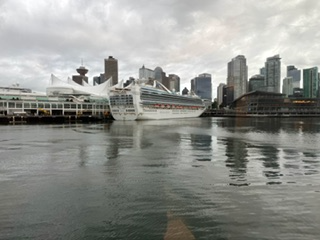
The last day on the ship. We watched thick forests glide by and suddenly we were in the port of Vancouver. The ship you see is about four times the size of ours. Beautiful city, but we’re heading home. We got home in the evening. LA is flat and treeless and full of lawyer billboards. Even so, it’s good to be home.
Victoria

July 10, 2026
Butchart Gardens is outside Victoria. We had high tea as part of the tour and then explored the gardens. That’s gardens, plural, as there are several different environments. Pictured is the Japanese garden, a calm change from the riot of color in the other gardens. We wandered through a sequioa forest that opened onto a brilliant sunken garden.
Seymour Narrows

july 9, 2026
A day at sea. The morning was 15-foot waves, with the wind blowing the foam from the tops of the crests in long streams. The ship was remarkably smooth, just made us feel a little tipsy. Then we entered the narrows. Pine-covered hills on both sides of the ship and smooth water, flat enough for water skiing.
We attended several interesting lectures—bears, entertaining at the White House, photography, AI. This is a very roomy ship for the number of passengers, so it’s easy to find a comfy and quiet place to do some reading.
Prince Rupert

July 8, 2026
Back in Canada. Prince Rupert advertises 100 days of sunshine. This was not one of them. This was the most rain we’ve had this trip. That’s what keeps it so green and beautiful. There is a big, pine-covered mountain behind those clouds. We ventured out to the museum of local culture, in foreground, a replica of a Tsimshian long house where multiple families would traditionally live. Interesting ancient tools, ceremonial robes and art by modern Native artists. Then back to the ship to dry off.
Klawock

July 7, 2026
We chose this cruise for the opportunity to get to little-known ports like this one. Klawock is a Tlingit village. These are restorations or reproductions of the original totem poles from their old winter village. A local woman explained them all to us. Some tell ancient tales of mythical creatures. Others say things somewhat like “I’m rich and important” or “You kids were bad.”
We walked through the forest with a local man who described the various plants and how they use them. He talked about growing up hunting and foraging and then doing logging and now his current job is touching up the paint on standing totem poles. Very interesting. Cold, but at least it’s not raining.
Wrangell/Anan Bear Observatory

July 6, 2026
This is one of the most prolific salmon rivers in Alaska. And the bears know it. A limited number of people can come in here and watch the bears from the blind seen in the lower right. Getting here requires a long boat ride and a hike led in a tight group by guides with guns and bear spray.
Luckily only a little drizzle. We made it! No salmon. No bears. Well, it was a wonderful boat ride among the steep and forested islands and a great hike through this forest.
Icy Strait Point/Hoonah

July 5, 2026
This area has the world’s highest density of coastal brown bears in the world and we took a van tour in search of them. Our Tlingit driver knew all the signs of bears, which was interesting, but, alas we didn’t see any. The forest is so dense that you can see wildlife only if they are on the road or a beach. But we did see two bald eagles and two Sitka white-tail deer. The scenery is spectacular.
We came back through Hoonah, the largest Tlingit village in Alaska. It looked refreshingly non-touristy. We thought we’d stop but it was Sunday and everything was closed even with three cruise ships in town.
Hubbard Glacier

July 4, 2026
No fireworks today. But there was a fun party with American music and food at lunch time (None of the musicians was American). Our destination today is Hubbard Glacier, one of the few glaciers in the world that is advancing. The morning started with an interesting lecture about glaciers. We claimed a good view early and watched as the amount of ice in the sea increased as we approached. There are strict regulations to keep the glacial area pure. Only one ship at a time can be there. We were next in line after the ship that’s seen near the glacier on the left. It stayed there and seemed unwilling to leave. Eventually our ship turned and headed back. This was as close as we got. Disappointing.
Sitka

July 3, 2026
We’re in Sitka, on an island with three times as many bears as people. We took a private van tour of all 14 miles of roads. We didn’t see any bears, but we saw a seal at a distance and some possible bald eagles in a tree, and lots of beautiful scenery. We found and sampled some wild salmonberries.
This remote town was, surprisingly, the capital of Russia’s North American colony in the 1700s.Then it became the first capital of Alaska. There is a lovely onion-domed church in town. We toured the home of the Russian bishop who gave the Tlingit a written language. Then back to the ship to get out of the rain.
Ketchikan

Thursday, July 2
They say that if you’re in Ketchikan when it’s not raining, your luck is so good you should buy a lottery ticket. Well, we lucked out. Here we are in Ketchikan, where they measure rain in feet, and not only is it not raining but it’s warm and sunny.
We went to Saxman, a Tlingit village outside of town for a tour of the clan house, traditional dances, totem poles and a carving shed. Brave audience members got to join the dances (Carol, not Jerry). We learned about the meaning of the totem poles, the stories they told or those they honored or shamed.
Afterward a stroll through town. Houses on stilts (many former brothels) sit above the creek where salmon run (but not this time of year). Totem poles in town with interpretive signs telling their stories.
Back on the ship for another extravagent dinner. On to Sitka.